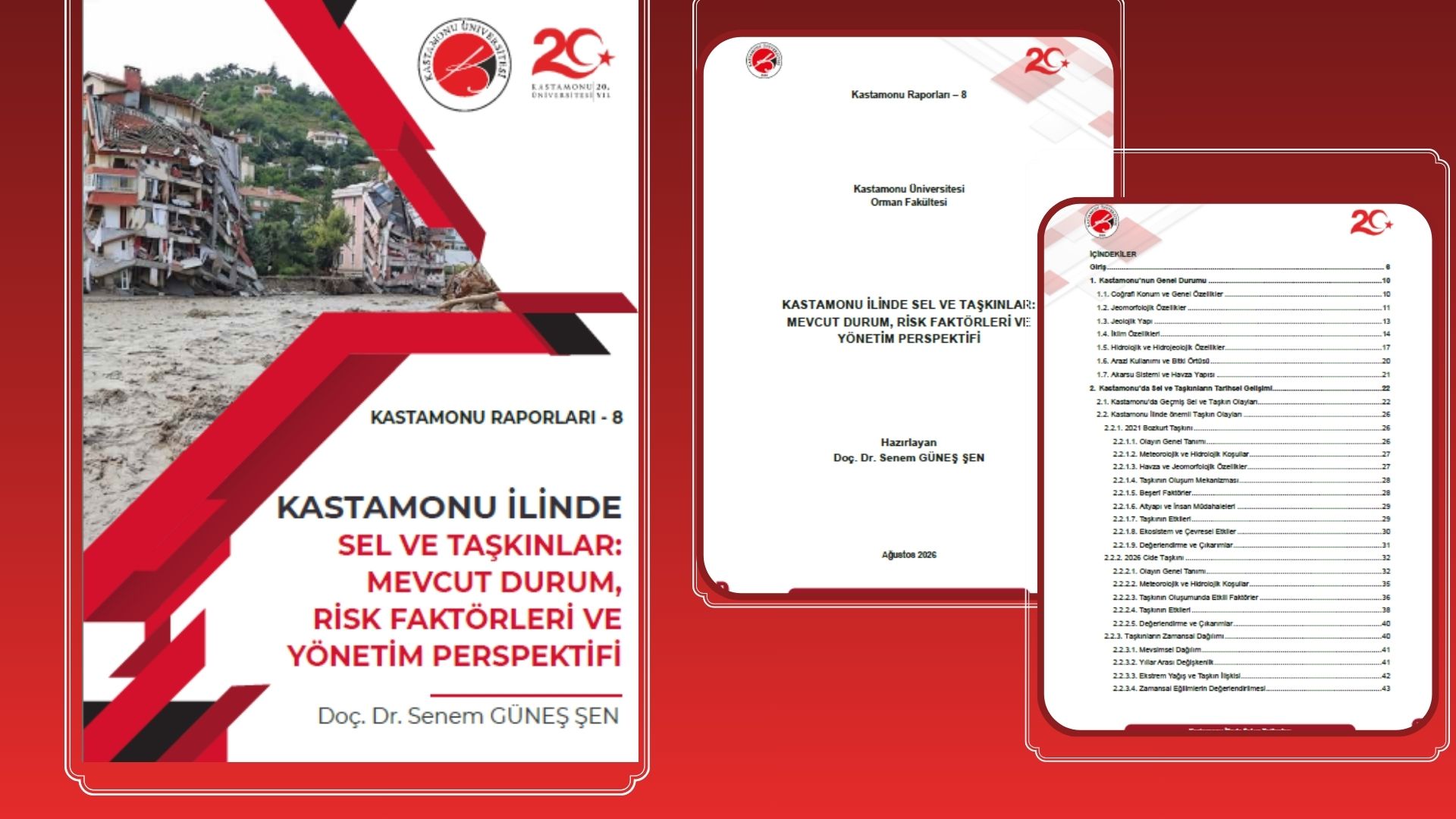
The 8th study of the "Kastamonu Reports" series, prepared by Kastamonu University, has been published. In the study titled "Floods and Inundations in Kastamonu Province: Current Situation, Risk Factors, and Management Perspective," prepared by our university's Faculty of Forestry faculty member, Assoc. Dr. Senem Güneş Şen evaluated the natural and human factors affecting the occurrence of floods and inundations in Kastamonu based on scientific data.
In the report, the geographical location, geomorphological and geological structure, climatic characteristics, hydrological structure, land use, vegetation cover, and river and basin systems of Kastamonu were examined in detail with respect to flood and inundation risk. The study also included the historical development of past flood and inundation events.
2021 Bozkurt and 2026 Cide Floods Evaluated
In the study, the 2021 Bozkurt and 2026 Cide floods, which occurred recently in Kastamonu, were examined in detail. Both floods were evaluated in terms of meteorological and hydrological conditions, basin characteristics, infrastructure elements, human interventions, and environmental impacts.
The report emphasized that short-term and high-intensity rainfall increases the risk of flooding, especially in small and medium-sized coastal basins. It was stated that the high-slope, narrow-valley structure of the Kastamonu basins, along with the dense drainage network, plays a decisive role in the formation of floods.
Natural and Human Factors Were Considered Together
In the "Flood and Flood Formation Mechanism" section of the report, rainfall characteristics, topography, basin morphometry, geological structure, and soil properties were evaluated as natural factors. Land use, changes in vegetation cover, urbanization, settlement patterns, and human interventions were examined as anthropogenic factors.
In the study, which also analyzed long-term rainfall data, it was revealed that floods are influenced not only by the total amount of rainfall but also by the intensity, duration, and temporal distribution of the rainfall, as well as the topographic, hydrological, and ecological characteristics of the basins.
Critical Basins and Future Risks Examined
In the basin-based analysis section of the report, the Ezine Stream, Devrekani Stream, and Gokirmak basins, as well as small basins that drain directly into the Black Sea, were evaluated for flood risk.
The study also addressed the potential effects of climate change on the flood and inundation risk in Kastamonu. It was emphasized that changes in short-term, high-intensity rainfall could increase the risk of flooding in the future.
In the report, which includes recommendations for risk reduction, emphasis was placed on developing flood hazard maps, strengthening early warning systems, promoting nature-based solutions, increasing inter-institutional cooperation, and ensuring active community participation throughout the process.
"We are Bringing Our Scientific Knowledge Together with the Needs of Our City"
Our Rector, Prof. Dr. Ahmet Hamdi Topal, stated that the Kastamonu Reports series is a work that brings together our University's scientific accumulation and the city's needs.
Our Rector, pointing out the importance of evaluating the problems faced by Kastamonu using scientific data, emphasized that floods and inundations should not be considered only as issues that emerge only after a disaster.
Our rector also emphasized the importance of identifying risks in advance and developing necessary measures based on scientific data, and thanked Assoc. Prof. Dr. Senem Güneş Şen for preparing the report.
To access the report, click here.