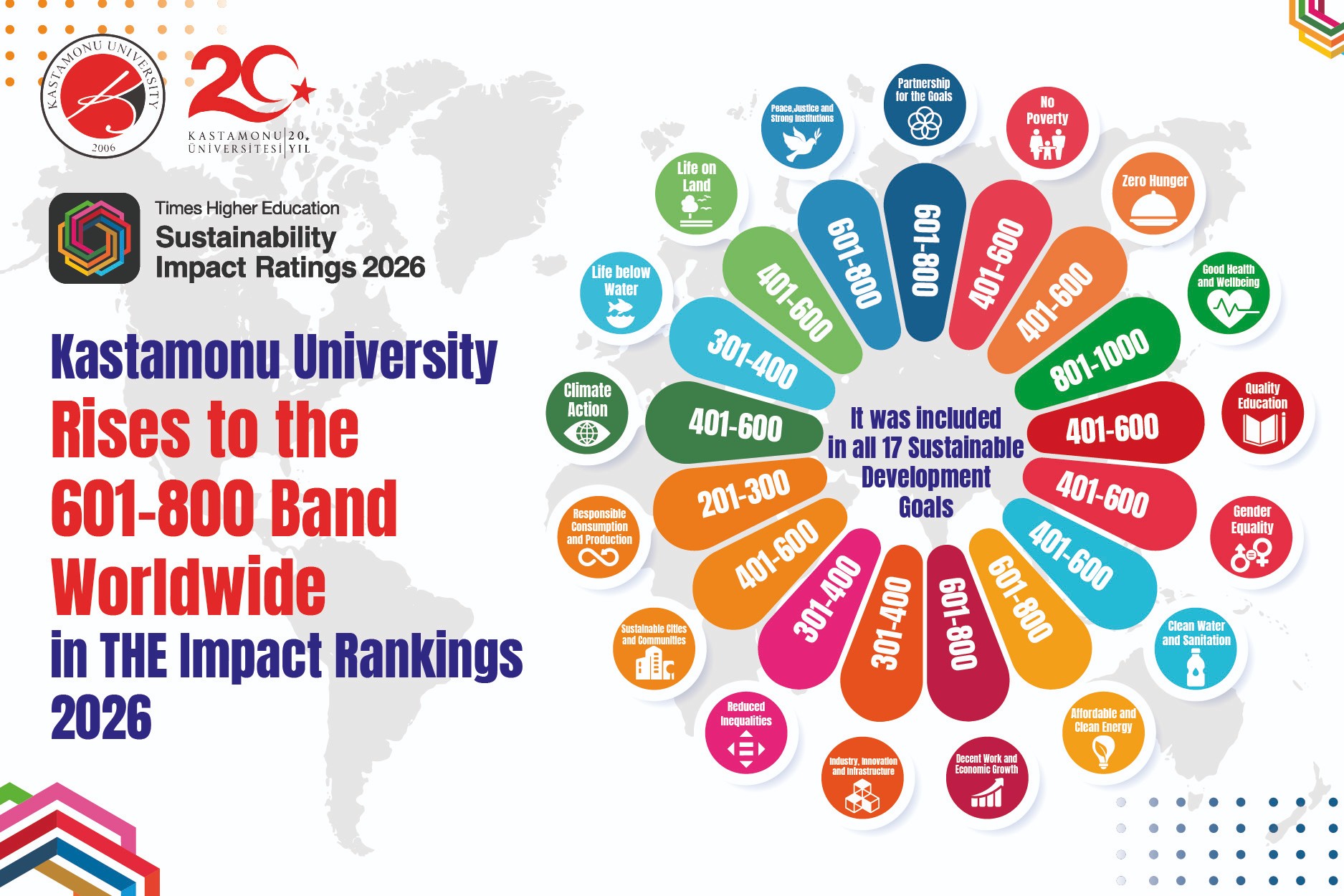
Kastamonu University improved its ranking in the United Nations Sustainable Development Goals within the Impact Rankings announced by Times Higher Education (THE) for the 2026 results.
Our university, which was in the 1001–1500 band in 2025, rose to the 601–800 band in 2026. In the ranking of universities' performance in social contribution, sustainability, education, research, and institutional practices, our university was included in 11 sustainable development goals in 2025 and in all 17 in 2026.
According to the 2026 results, our University has entered the rankings in some categories for the first time this year. Our university, which ranked in the 401–600 band in the categories of No Poverty and Gender Equality, was ranked in the 301–400 band in the category of Reduced Inequalities and in the 601–800 band in the categories of Decent Work and Economic Growth and Peace, Justice, and Strong Institutions.
Our university, ranked in the 301–400 band in the categories of Life Below Water, Industry, Innovation and Infrastructure, and Reduced Inequalities, and in the 201–300 band in the category of Responsible Consumption and Production, was placed in the 401–600 band in the categories of No Poverty, Zero Hunger, Quality Education, Gender Equality, Clean Water and Sanitation, Sustainable Cities and Communities, Climate Action, and Life on Land.
This year, our University ranked in all 17 categories, placing in the 601–800 band in the categories of Affordable and Clean Energy, Decent Work and Economic Growth, Peace, Justice and Strong Institutions, and Partnerships for the Goals; and in the 801–1000 band in the category of Good Health and Well-being.
Our Rector, Prof. Dr. Ahmet Hamdi Topal, stated that the achieved result reflects our University's sustainability approach and efforts.
Our Rector, noting that our university conducts studies aimed at social contribution and the Sustainable Development Goals in addition to academic production, emphasized that being ranked in all 17 Sustainable Development Goals demonstrates that this approach is recognized on an international scale.
Our Rector thanked the academic and administrative staff, students, stakeholders, the President of the Higher Education Council (YÖK), Prof. Dr. Erol Özvar, and the YÖK members for their contributions during the process.