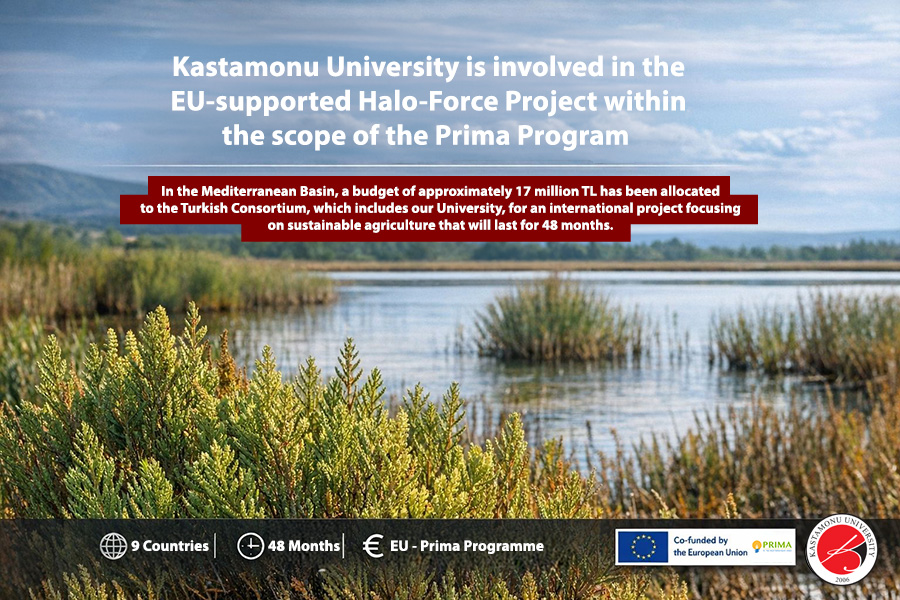
Kastamonu University continues to participate in international research studies in sustainable agriculture, biodiversity, and combating climate change. In the international project titled "HALO-FORCE: Halophyte-Driven Innovation for Sustainable Farming in Mediterranean Wetlands," which was selected for funding by the European Union under the PRIMA Program and has a total budget of 2,696,250 euros, approximately 17 million TL was allocated to the Turkish consortium, which includes Kastamonu University.
As part of a project to be carried out in the wetlands of the Mediterranean basin, the aim is to examine the genetic, physiological, and nutritional characteristics of edible halophyte plant populations, including wild beet. The project aims to develop climate-resilient agricultural systems, conserve biodiversity, and support sustainable water management practices.
The HALO-FORCE Project, which will last 48 months, is being carried out by a broad international partnership comprising numerous institutions from Italy, Portugal, Cyprus, Greece, Croatia, Egypt, Turkey, Morocco, and France. The University of Padua in Italy is the general coordinator of the project, while the Turkish part is led by Iğdır University, with our university, Bolu Abant İzzet Baysal University, and Türkiye Şeker Fabrikaları A.Ş. participating as partners.
Our university is contributing to the project through faculty members from the Department of Engineering and Architecture, Genetics and Bioengineering, Prof. Dr. Mehmet Cengiz Baloğlu and Prof. Dr. Yasemin Çelik Altunoğlu, as well as Expert Biologist Pınar Baloğlu from the Central Research Laboratory Application and Research Center (MERLAB).
Researchers are actively involved in the project, bringing expertise in plant biotechnology, molecular genetics, stress biology, and advanced bioinformatics.
The scientific outputs generated within the scope of the project aim to reveal the agricultural potential of halophyte plants, develop strategies for the sustainable use of wild beet genetic resources, and create innovative production models adapted to climate change. In this respect, the HALO-FORCE Project is considered a study that will contribute to both academic knowledge production and agricultural and environmental policies.
Our Rector, Prof. Dr. Ahmet Hamdi Topal, congratulated the academics and researchers involved in the studies carried out within the scope of the HALO-FORCE Project, and emphasized the importance of the approaches to be developed and the scientific outputs to be obtained within the scope of the project being integrable with public institutions and practitioner stakeholders in the fields of agriculture, environment, and ecosystem management. In this context, he stated that international collaborations, including those involving our university, contribute to universities' research capacity and scientific visibility.
Additionally, our Rector thanked YÖK President Prof. Dr. Erol Özvar for their contributions to research activities in higher education, and TÜBİTAK President Prof. Dr. Orhan Aydın for the support provided for our University's research infrastructure.