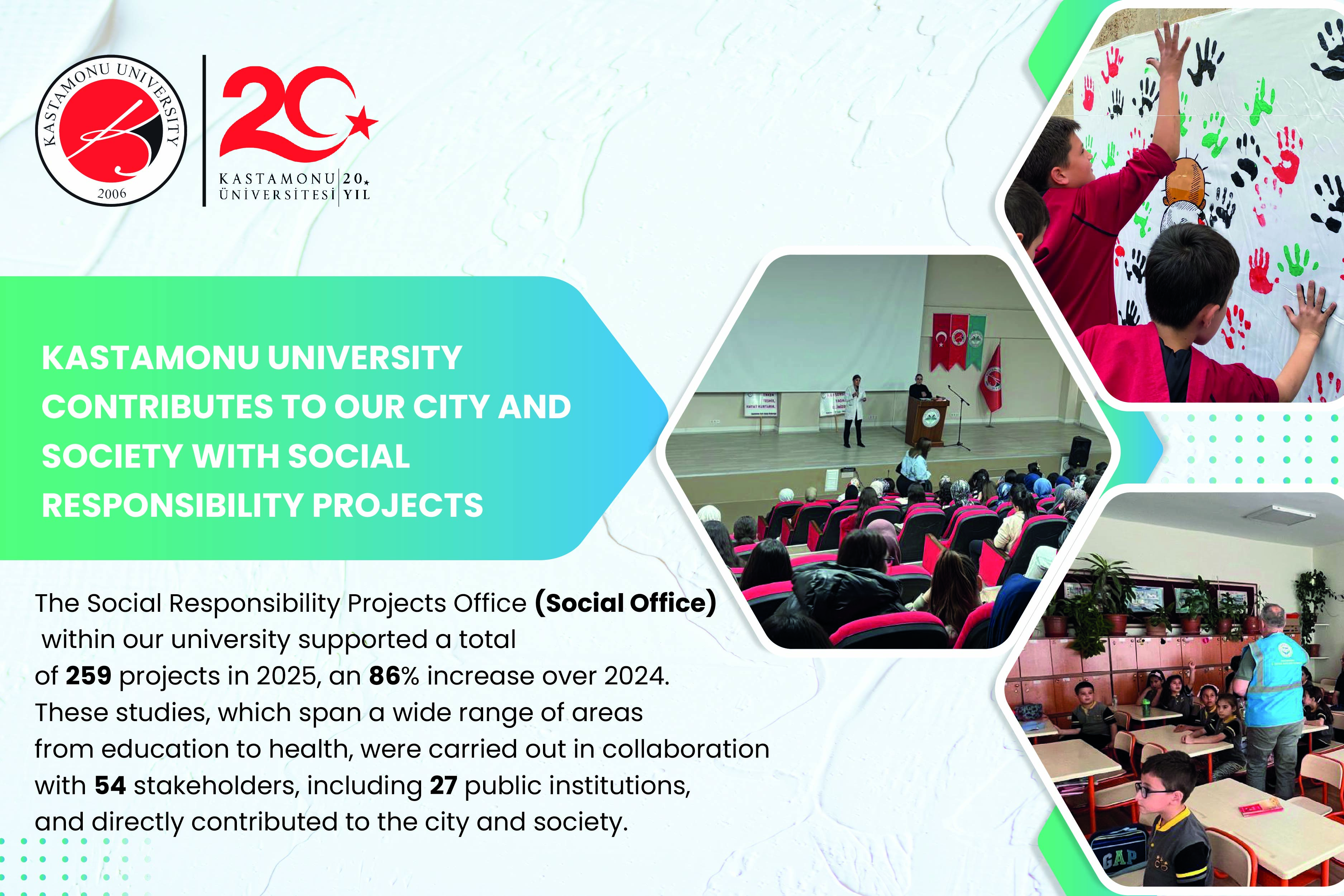
The Social Responsibility Projects Office (Social Office) within Kastamonu University has published the 2025 Activity Report, which includes the work carried out throughout 2025. The report details the increasing interest in social responsibility projects across our university, our implementation capacity, and the results reflected in the field, supported by comprehensive data.
According to the report, 481 social responsibility project applications were submitted from across our university in 2025. At the end of the evaluation process, 259 projects were implemented. Of the accepted projects, 130 were led by students and 129 by academics.
2025 was a year when the Social Responsibility Projects Office issued calls for special project topics, and thematic studies focusing on specific social areas came to the forefront. In this context, three separate special project calls were announced during the year. In April, projects themed around "Family" were supported; in May, projects on "Artificial Intelligence" were supported; and in October, projects developed under the theme of "Combating Addiction" were prioritized. The studies were reflected in the field under the headings of education, health, sports, environment, social awareness, and support for disadvantaged groups.
While projects are carried out within a broad academic structure, from faculties to vocational schools, the Faculty of Economics and Administrative Sciences, with 75 projects, the Faculty of Health Sciences, with 44 projects, and the Faculty of Sports Sciences, with 32 projects, were among the units that stood out with the number of projects accepted. All of the projects carried out were linked to the United Nations Sustainable Development Goals, making a direct contribution to the goals of Quality Education, Good Health and Well-being, and Reduced Inequalities in particular.
The report stated that approximately 780,000 TL of the budget was used during project implementation and that widespread participation was encouraged through an average support model of 3,000 TL per project. As part of the studies, collaboration was carried out with a total of 54 stakeholders, including 27 public institutions such as the Kastamonu Governorate, central and district municipalities, Provincial and District Directorates of National Education, Provincial Directorate of Health, AFAD, Provincial Directorate of Youth and Sports, Provincial Directorate of Family and Social Services, healthcare institutions, nursing homes, and care centers; as well as organizations serving women and individuals with special needs, and representatives from the private sector.
The report's comparative data showed that the number of project applications increased by approximately 94% from 2024, and the number of approved projects increased by over 86%. During this process, student projects increased by 86.1%, while faculty projects increased by 89.7%. This increase showed a steady rise in interest in social responsibility projects across our university.
Commenting on the report, our Rector, Prof. Dr. Ahmet Hamdi Topal, stated that social responsibility activities hold a significant place in our University's approach to society, using the following words:
“We believe that universities should take responsibility not only through their educational and research activities but also through their work that directly impacts society. The 2025 Activity Report, prepared by our Social Responsibility Projects Office, reflects the sensitivity of our students and academics toward social issues and their understanding of co-creation. We believe it is important to continue this work in the coming period. I would like to thank the project owners, all stakeholders, and everyone involved.”