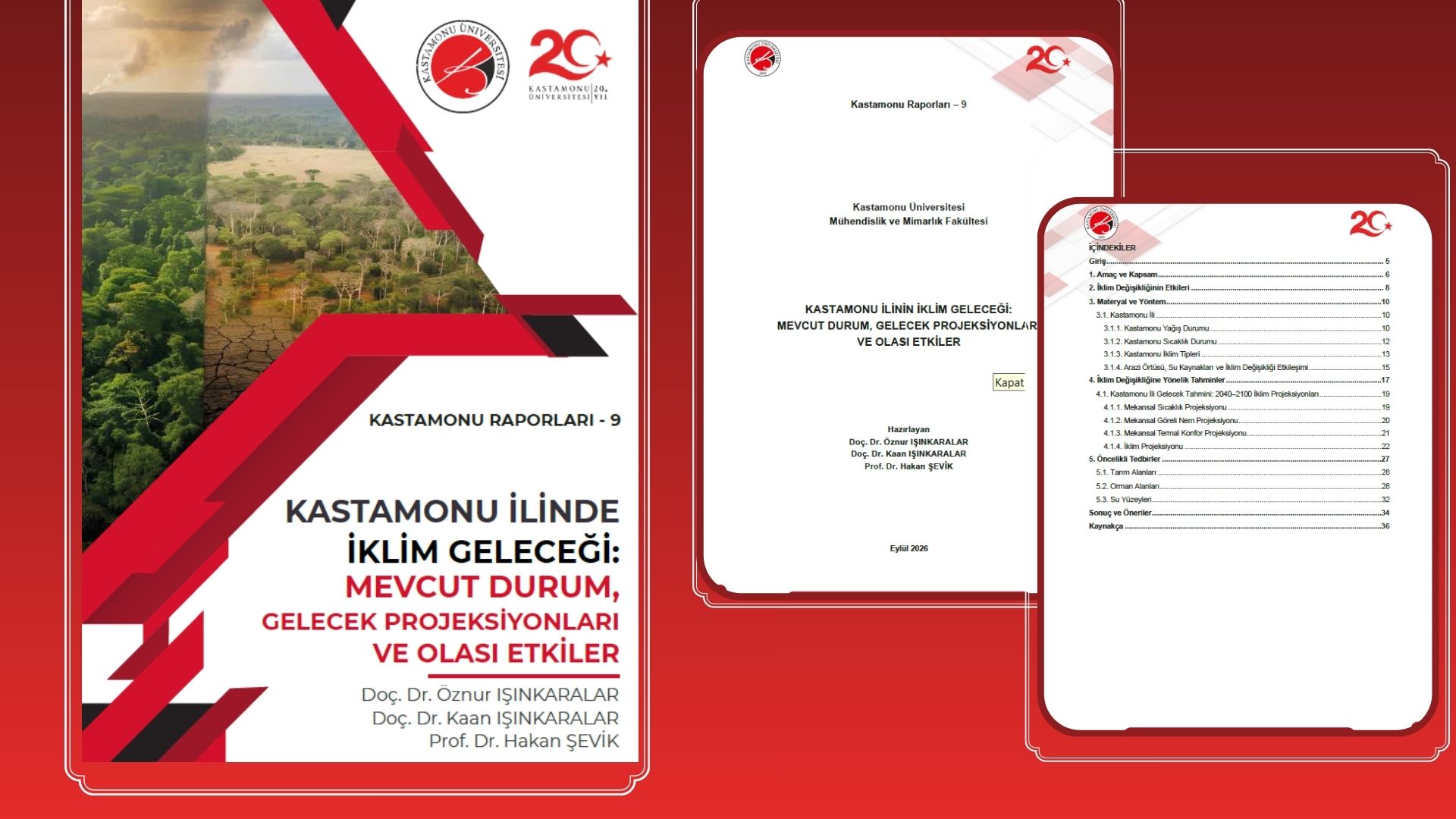
The 9th study of the Kastamonu Reports series, prepared by Kastamonu University, has been published.
In the report titled "Climate Future in Kastamonu Province: Current Situation, Future Projections, and Possible Impacts," prepared by Assoc. Prof. Dr. Öznur Işınkaralar, Assoc. Prof. Dr. Kaan Işınkaralar, and Prof. Dr. Hakan Şevik, the current climate structure of Kastamonu and potential future changes were examined in light of scientific data.
In the study, different elements that constitute the climate structure of Kastamonu, such as temperature and precipitation characteristics, climate types, land cover, and water resources, were examined. In the projections prepared with 2020 as the reference year, the changes that may occur in 2040, 2060, 2080, and 2100 were evaluated through different climate scenarios.
The projections in the report indicate that in the coming years, the increase in temperature in Kastamonu may become more pronounced, and especially under high emission scenarios, the pressure of drought may increase. It is considered that changes in the precipitation regime could affect the province's humidity structure and that some of the current dominant climate characteristics could change significantly in the future.
The report presents projections regarding temperature, precipitation, relative humidity, thermal comfort, and climate types, using maps and tables, while also emphasizing that the changes may vary across different regions of Kastamonu.
Agriculture, forests, and water resources were addressed
In the report, the potential impacts of climate change on Kastamonu were also evaluated in terms of environmental and economic dimensions.
Agricultural production, forest ecosystems, water resources, biodiversity, and human life were identified as the main areas that could be affected by future climate changes. It was stated that rising temperatures and changing rainfall patterns could increase pressure on water resources, create new adaptation needs in agricultural production, and cause different risks in forest ecosystems.
In the study, the effects of temperature and humidity changes on human life were also examined in terms of thermal comfort, and evaluations regarding the climate conditions that Kastamonu may face in the future were included.
Future measures were also included in the report
One of the important topics of the study was to create recommendations for Kastamonu's adaptation process to climate change.
In the report, which addresses measures that can be taken in different areas such as the protection of water resources, agricultural production, the future of forests, and urban planning, it was emphasized that the planning to be done should take into account the different geographical features of Kastamonu.
The study emphasizes the importance of using scientific projections in decision-making processes, presenting in detail the changes that could occur in Kastamonu according to different climate scenarios and the corresponding recommendations.
"Scientific data is of great importance in preparing for the future."
Our Rector, Prof. Dr. Ahmet Hamdi Topal, stated that climate change is an issue that affects many areas, from agriculture to water resources, from forests to urban life.
Our Rector, stating that the preservation of Kastamonu's natural riches and their transfer to future generations should be supported by data-driven studies, said that revealing the current situation of the province and preparing projections for the future would contribute to measures to be taken against climate change.
Emphasizing that universities have the responsibility not only to produce scientific knowledge but also to contribute to the understanding and solution of the problems faced by cities, our Rector stated that the Kastamonu Reports series also presents the current situation of the city in various fields in light of scientific data with this understanding.
Our Rector, Prof. Dr. Ahmet Hamdi Topal, thanked Assoc. Prof. Dr. Öznur Işınkaralar, Assoc. Prof. Dr. Kaan Işınkaralar, and Prof. Dr. Hakan Şevik for their contributions to the preparation of the study and wished that the report would be beneficial for Kastamonu.
To access the report, click here.