Kastamonu University, while steadily continuing its R&D and innovation-focused studies, is demonstrating its steps toward transforming academic knowledge production into economic and social benefit with concrete results in the field of intellectual and industrial property.
Founded in 2006, our university filed its first patent application in 2011. By the time the Technology Transfer Office became operational in 2020, a total of 22 patent applications had been filed under the ownership of our University. Twelve of these applications were registered by the Turkish Patent and Trademark Office and added to the intellectual property inventory.
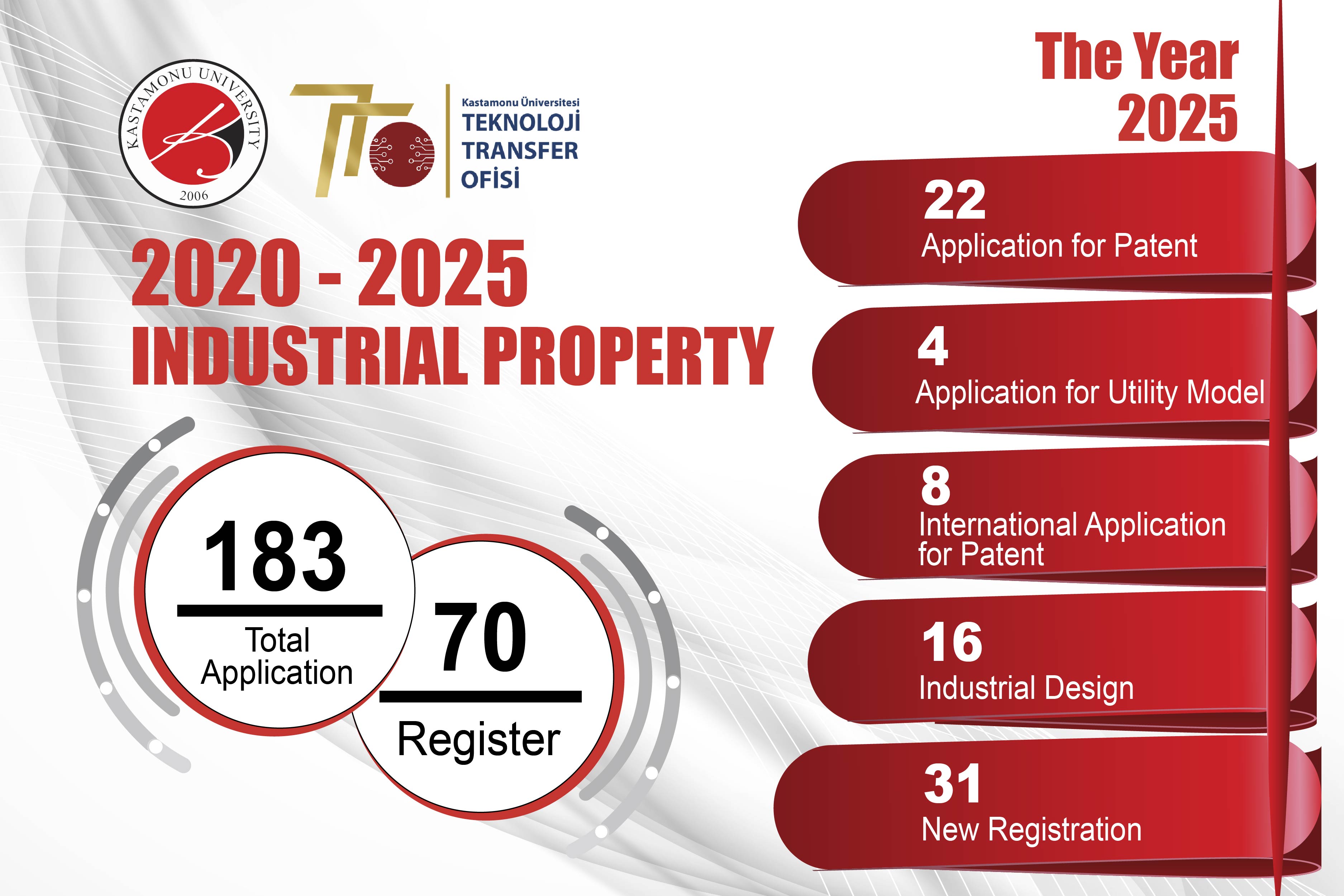
With the establishment of the Technology Transfer Office in 2020, intellectual and industrial property processes began to be managed under the coordination of the Patent Support Office within the TTO. With the opening of this office, there was a significant increase in the number of applications. Between 2020 and 2025, a total of 183 industrial property applications were filed under the ownership of our University, including 92 national patents, 21 utility models, 21 international (PCT) patents, and 49 industrial designs.
Specific to the year 2025, 4 utility models, 8 international (PCT) patents, 22 patents, and 16 industrial design applications were filed. Within the same year, 13 patents/utility models, as well as 18 industrial designs, were registered and protected by the Turkish Patent and Trademark Office.
Examining the results of applications submitted after 2020, a total of 70 industrial property rights were registered, comprising 34 patents/utility models, as well as 36 industrial designs.
Commenting on the issue, our Rector, Prof. Dr. Ahmet Hamdi Topal, emphasized the importance of preserving and recording the knowledge produced in universities.
Our Rector stated, "The evaluation of academic studies within the scope of intellectual and industrial property is important for the permanence of universities' scientific output. We continue to support our researchers in this field and encourage the transformation of emerging knowledge and designs into social and economic value”.